How to Improve AI Search Visibility for Your Local Business
AI search is changing how people discover businesses, products, services, and information online.
Instead of typing a short keyword into Google and scanning search results, people can now ask complete questions and receive answers through Google AI Overviews, Google AI Mode, ChatGPT, Perplexity, Microsoft Copilot, Gemini-powered search experiences, and other generative search platforms.
That creates a new visibility challenge:
How do you make your business discoverable, understandable, retrievable, verifiable, and trustworthy enough to appear as a relevant source in AI-generated search results?
The answer isn't simply adding more keywords to a website.
Modern search depends on a combination of traditional SEO, semantic relevance, entity relationships, structured business information, authoritative content, local search signals, citations, technical accessibility, and evidence across the web.
What Is AI Search Visibility?
AI search visibility is the ability of a business, organization, website, product, or service to be discovered and represented within AI-powered search experiences.
This can include:
- Google AI Overviews
- Google AI Mode
- ChatGPT
- Perplexity
- Microsoft Copilot
- Gemini-powered search
- Answer engines
- Generative search
- Conversational search
- Voice search
- Multimodal search
Google explains that AI Overviews and AI Mode use Search systems to retrieve relevant information and may use a process called query fan-out, where related searches are generated to explore different aspects of a user's question.
That means the goal isn't to "hack the AI."
The goal is to make your business easy for search systems to find, understand, connect, verify, and reference.
How Do You Increase Visibility in AI Search?
Improving AI search visibility requires a broader approach than traditional keyword optimization.
A strong AI search strategy should address seven interconnected areas:
- Discovery
- Understanding
- Retrieval
- Verification
- Trust
- Citation
- Recommendation
These areas provide a framework for understanding how information about a business can move through modern search systems.
1. Make Your Business Discoverable
Before an AI system can understand or reference your business, it has to be able to find the information.
That begins with basic technical SEO.
Your website should be:
- Crawlable
- Indexable
- Accessible
- Internally linked
- Mobile-friendly
- Clearly structured
- Free from unnecessary technical barriers
For example, consider a general contractor serving Arvada and surrounding communities.
If the contractor's website clearly identifies the company, services, service areas, contact information, project information, and other important business details, search systems have more information available to understand the business.
Your website is still the foundation.
AI search doesn't eliminate websites.
It makes having a clear, understandable digital entity even more important.
2. Make Your Business Easy for AI to Understand
Search systems don't simply match individual keywords.
Modern search systems can interpret:
- Entities
- Topics
- Relationships
- Services
- Locations
- Organizations
- People
- Products
- Attributes
- Search intent
- Context
Consider a local general contractor.
The underlying concepts could include:
General Contractor → Home Remodeling → Kitchen Remodeling → Bathroom Remodeling → Arvada → Denver Metro → Residential Construction → Google Business Profile → Google Maps → Local Search
That's an entity relationship.
A well-structured website makes these relationships clear.
Instead of repeatedly writing:
- general contractor Arvada
- Arvada general contractor
- best general contractor Arvada
- general contractors near Arvada
a stronger approach is to clearly explain:
Who the contractor is, what services the contractor provides, where those services are available, what types of projects the contractor handles, and how customers can contact the business.
That is semantic SEO.
3. Create Content AI Systems Can Retrieve
AI search systems need useful information to retrieve.
Google's guidance emphasizes creating unique, valuable, helpful, reliable, people-first content, rather than mass-producing generic pages designed primarily to manipulate search or generative AI results.
Weak AI-Search Content
- Generic
- Repetitive
- Keyword stuffed
- Lacking first-hand experience
- Nearly identical to competing pages
- Written primarily for algorithms
Strong AI-Search Content
- Specific
- Useful
- Well organized
- Demonstrates expertise
- Answers real questions
- Provides original information
- Clearly explains products and services
- Uses supporting evidence where appropriate
For a roofing contractor, for example, useful content might answer:
What roofing services does the company provide?
What areas does the company serve?
What does a roof replacement involve?
How long does a roof replacement typically take?
When should a homeowner repair versus replace a roof?
What types of roofing systems does the contractor install?
These questions naturally create the semantic relationships that search systems need to understand the topic.
4. Build Strong Entity Relationships
One of the biggest differences between traditional keyword SEO and modern search optimization is the importance of entities and relationships.
An entity can be a:
- Business
- Person
- Organization
- Location
- Product
- Service
- Brand
- Topic
- Place
- Institution
For a local business, the digital entity might look something like:
General Contractor
→ Home Remodeling
→ Kitchen Remodeling
→ Bathroom Remodeling
→ Basement Finishing
→ Deck Construction
→ Arvada
→ Denver Metro
→ Google Business Profile
→ Google Maps
→ Customer Reviews
→ Project Portfolio
The website should consistently establish these relationships.
That means the:
- Homepage
- About page
- Service pages
- Location pages
- Google Business Profile
- Business directories
- Social profiles
- Reviews
- Articles
- Structured data
should reinforce accurate information about the same business entity.
5. Strengthen Business Information and Citations
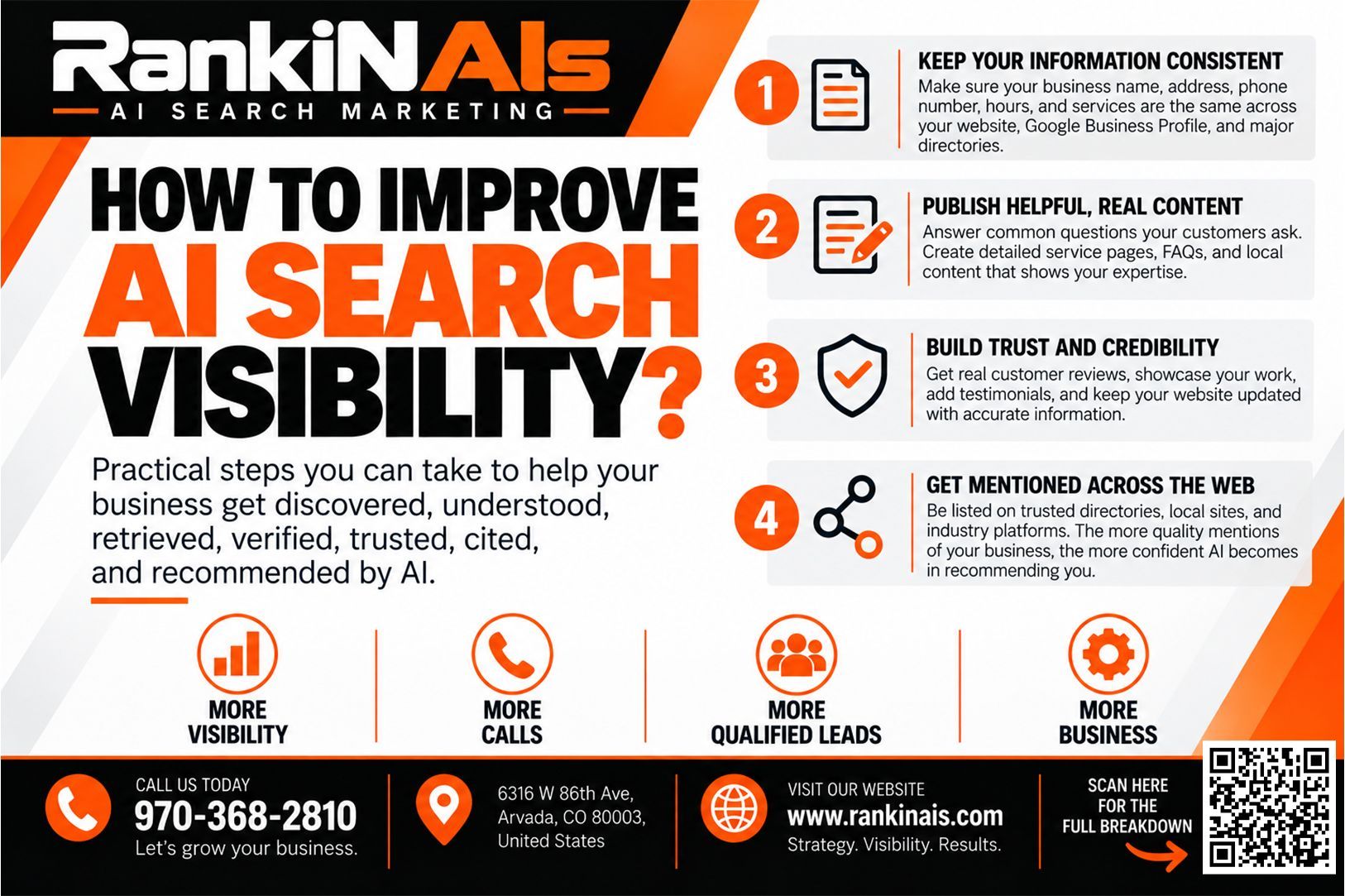
For local businesses, consistency matters.
Your business name, address, phone number, website, hours, services, categories, and other important information should be accurate across the web.
This can include:
- Google Business Profile
- Bing
- Apple Maps
- Yelp
- Industry directories
- Local directories
- Social profiles
- Review platforms
- Business associations
- Relevant publications
For example, if a plumbing company is listed with one phone number on its website and a different phone number on several directories, the business information is inconsistent.
A cleaner digital presence clearly establishes:
Who you are.
What you do.
Where you operate.
How customers can contact you.
How your business is represented across the web.
This is where citation engineering becomes important.
A citation isn't simply another directory listing.
It can contribute to a broader digital footprint that helps establish the identity and legitimacy of a local business.
6. Build Evidence and Trust
AI systems have access to enormous amounts of information.
Simply saying:
"We are the best general contractor."
doesn't establish much.
Evidence is stronger.
For a local contractor, supporting information could include:
- Detailed service information
- Project portfolios
- Case studies
- Customer experiences
- Reviews
- Business profiles
- Industry references
- Credentials
- Author information
- Demonstrated expertise
- Consistent company information
- Relevant third-party mentions
- Helpful educational content
The objective is to create a verifiable digital footprint.
The strategy shouldn't be:
"How many websites can mention my company?"
It should be:
"How can I build a credible, consistent, useful presence across the places where my business should legitimately exist?"
7. Optimize for Questions, Not Just Keywords
AI search is increasingly conversational.
Someone looking for a contractor might not search:
"general contractor Arvada."
They might ask:
"Who provides home remodeling services in Arvada?"
Or:
"What should I look for when choosing a general contractor?"
Or:
"How much does a kitchen remodel usually involve?"
Or:
"Does this contractor serve homeowners in my area?"
These questions create opportunities for businesses that build content around search intent and real customer questions.
Instead of creating dozens of pages targeting tiny keyword variations, create comprehensive resources that answer meaningful questions.
The objective is to provide information that is useful to people while also creating clear semantic relationships for search systems.
AI Search Visibility Requires More Than Website SEO
Your website remains extremely important, but AI search visibility extends beyond your website.
Think of your digital presence as an ecosystem.
Website
Your website establishes your primary business information, services, expertise, locations, and content.
Google Business Profile
Your Business Profile connects your business with Google Search and Google Maps.
Local Listings
Directories and business listings reinforce your business identity and location information.
Content
Articles, guides, FAQs, service pages, and resources demonstrate topical knowledge and answer customer questions.
Reviews
Customer feedback provides real-world experiences associated with the business.
Structured Data
Structured data can help search engines classify and understand information on your pages when implemented accurately and matched to visible content.
External References
Relevant third-party websites, publications, organizations, and other legitimate sources can provide additional context about your business.
Together, these elements create a more complete digital representation of the business.
AI Search Optimization vs. Traditional SEO
Traditional SEO and AI search optimization aren't competing strategies.
Traditional SEO remains foundational to modern search visibility.
Traditional SEO focuses heavily on areas such as:
- Keywords
- Search rankings
- Technical SEO
- Content
- Links
- Search intent
- Website structure
AI search adds additional emphasis to:
- Entities
- Relationships
- Questions
- Context
- Information retrieval
- Business verification
- Evidence
- Citations
- Connected information
The two approaches work together.
A technically strong website with useful content remains important.
The difference is that businesses now have to think about how their information is understood across the broader search ecosystem.
Technical SEO Still Matters
AI search doesn't mean technical SEO has disappeared.
Your website should still have:
- Crawlable pages
- Indexable content
- Logical site architecture
- Internal linking
- Descriptive titles
- Useful headings
- Clean URLs
- Mobile usability
- Accessible content
- Proper canonicalization
- Accurate structured data
- XML sitemap
- Appropriate robots directives
You also don't need to create special "AI-only" content or special markup simply to qualify for Google's AI features.
The opportunity is to make your existing SEO foundation:
Clearer.
More useful.
More authoritative.
More connected.
Content Optimization for AI Search
A strong AI-search content strategy should cover the complete topic rather than obsessing over keyword density.
For example, a page about general contracting services could naturally cover:
- General contractor
- Home remodeling
- Kitchen remodeling
- Bathroom remodeling
- Basement remodeling
- Construction services
- Residential construction
- Service areas
- Project planning
- Building materials
- Contractor licensing
- Customer reviews
- Local search
- Google Maps
- Google Business Profile
- Search intent
- Qualified leads
These aren't words that should simply be inserted into paragraphs.
They are related concepts within the same topic and entity ecosystem.
That's the difference between semantic optimization and keyword stuffing.
How to Measure AI Search Visibility
AI search visibility should be measured rather than assumed.
Important measurements can include:
- Organic search impressions
- Organic clicks
- Search queries
- Branded searches
- Non-branded searches
- Local visibility
- Google Maps performance
- Qualified leads
- Phone calls
- Form submissions
- Conversion rates
- Referral traffic
- AI search referrals where measurable
- Mentions and citations
- Search Console performance
The goal isn't simply to watch rankings.
The goal is to understand whether increased visibility is contributing to real customer activity.
For a local contractor, that could mean more homeowners discovering the company, visiting the website, requesting estimates, calling the business, or submitting project inquiries.
What About GEO and AEO?
You may hear terms such as:
GEO — Generative Engine Optimization
AEO — Answer Engine Optimization
AI SEO
AI Search Optimization
Generative Search Optimization
These are terms commonly used throughout the search marketing industry.
The terminology matters less than the underlying work:
Make useful information accessible, understandable, relevant, authoritative, and easy for search systems to retrieve.
Why AI Search Visibility Matters for Local Businesses
Local businesses have an important opportunity because search questions often include geographic context.
A homeowner might ask:
"Who offers emergency water damage restoration near me?"
Or:
"What's a good flooring contractor in Denver?"
Or:
"Who installs hardwood floors in Firestone?"
For a business to be considered relevant, its digital presence needs to clearly establish:
Business → Service → Location → Relevance → Evidence
That's why local SEO, Google Business Profile optimization, citations, entity optimization, content, and technical SEO increasingly work together.
The Future of Search Is About Being Understood
The old question was:
"How do I get my website to rank for this keyword?"
The modern question is becoming:
"How do I make my business clear, useful, relevant, and verifiable for the searches that matter to my customers?"
That requires more than a keyword list.
It requires a connected search ecosystem.
Your website needs to explain the business.
Your content needs to answer the questions.
Your local listings need to reinforce the information.
Your citations need to be accurate.
Your structured data needs to describe the right entities.
Your reputation needs to reflect real customer experiences.
And your digital presence needs to tell a consistent story.
That's the foundation of modern search visibility.