What Is AceTrace™?
AceTrace™: AI Citation Engineering for the Next Generation of Search
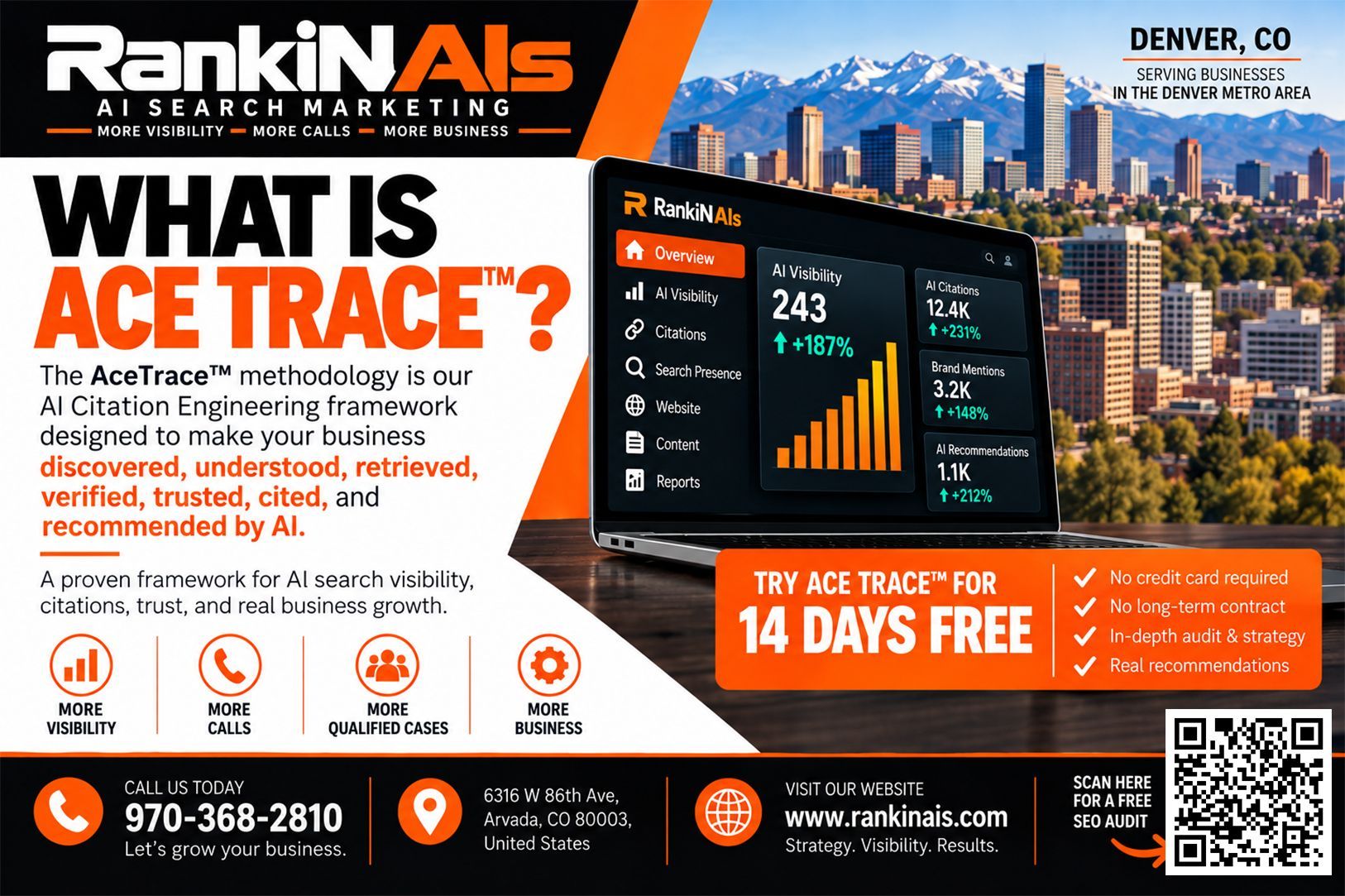
AceTrace™ is RankiN AIs’ AI Citation Engineering framework designed to help businesses become more discoverable, understandable, retrievable, verifiable, trusted, cited, and recommended across modern search environments.
Traditional SEO focuses heavily on helping a webpage rank for a search query. AceTrace™ takes a broader approach. It focuses on the information, relationships, entities, citations, authority signals, and supporting evidence that help search engines and AI-powered search systems understand what a business is, what it does, where it operates, and why it should be considered relevant.
As search evolves from traditional blue-link results toward AI-generated answers, businesses need more than keywords on a webpage. They need a clear and consistent digital identity that can be understood across websites, business listings, structured data, local search platforms, and other trusted sources.
That is the purpose of AceTrace™.
What Does AceTrace™ Mean?
AceTrace™ stands for AI Citation Engineering.
It is a framework developed by RankiN AIs for organizing and strengthening the digital signals surrounding a business so that search systems can more easily connect the business with relevant questions, services, locations, and customer needs.
AceTrace™ focuses on seven core stages:
Discovered → Understood → Retrieved → Verified → Trusted → Cited → Recommended
These stages describe the journey a business needs to support in an increasingly retrieval-driven search environment.
1. Discovered
Your business needs to be discoverable across the places where customers and search systems look for information.
This can include:
- Google Search
- Google Maps
- Business profiles
- Local directories
- Industry websites
- Your website
- Local publications
- Relevant third-party sources
- Search indexes
- AI-powered search experiences
2. Understood
Search systems need to understand what your business actually is.
That means clearly connecting:
Business → Services → Location → Industry → Expertise → Audience → Products → Topics
A page shouldn't simply mention a keyword repeatedly. It should provide meaningful context around the business and its services.
3. Retrieved
Relevant information needs to be accessible to search systems when a user asks a related question.
Google's current documentation explains that its generative search experiences can use retrieval-augmented generation and related searches to find supporting information before generating responses.
AceTrace™ therefore considers the accessibility, organization, relevance, and supporting evidence surrounding important business information.
4. Verified
AI-powered search needs reliable information to work from.
That makes consistency important.
Business information should align across relevant sources, including:
- Business name
- Address
- Phone number
- Website
- Business category
- Services
- Hours
- Locations
- Service areas
- Business descriptions
For local businesses, structured business information can also help Google understand details such as a business's name, address, telephone number, URL, hours, and geographic information.
5. Trusted
Visibility alone isn't enough.
A business also needs supporting signals that establish credibility.
AceTrace™ considers signals such as:
- Customer reviews
- Business information consistency
- Relevant citations
- Industry references
- Local authority
- Original content
- Demonstrated experience
- Reputation
- Supporting websites
- Accurate business information
Google's own guidance emphasizes helpful, reliable, original content and notes that its generative AI search systems continue to rely on foundational search and quality systems.
6. Cited
Citations are central to AceTrace™.
A citation is not simply a directory listing.
In the AceTrace™ framework, citations can function as supporting references that help establish relationships between a business, its services, its location, and its broader digital identity.
This includes relevant:
- Local business listings
- Industry directories
- Business profiles
- Organization references
- Local websites
- Publications
- Supporting pages
- Relevant third-party sources
The objective isn't to create thousands of meaningless mentions.
The objective is to build relevant, consistent, trustworthy evidence around the business.
7. Recommended
The final objective is to make the business easier for search systems to connect with relevant user needs.
For example:
“Who provides local SEO services in Denver?”
A traditional SEO strategy might focus on ranking a page for local SEO services Denver.
AceTrace™ asks a broader question:
Does the available digital evidence clearly establish that this business provides local SEO services, where it provides them, what those services include, and why the business is relevant to that question?
That distinction is at the heart of AI Citation Engineering.
AceTrace™ vs. Traditional SEO
AceTrace™ does not replace SEO.
It builds on SEO.
Google explicitly states that its existing SEO best practices remain relevant to AI features such as AI Overviews and AI Mode. Google also says there are no special requirements or separate “AI markup” required for these features.
The difference is primarily how the optimization problem is framed.
Traditional SEO FocusAceTrace™ FocusRankingsDiscoverability and retrievalKeywordsEntities and relationshipsWeb pagesDigital identityBacklinksRelevant supporting evidenceCitationsConsistent business referencesSearch queriesSearch intent and related questionsRankings reportsVisibility and performance signalsWebsite optimizationWebsite + entity ecosystemSearch resultsSearch and generative experiences
Traditional SEO asks:
“How do we help this page rank?”
AceTrace™ asks:
“How do we make this business easier for search systems to understand, retrieve, verify, cite, and connect with the right questions?”
What Does AceTrace™ Optimize?
AceTrace™ brings multiple areas of digital marketing and search optimization together.
Local SEO
Local search visibility, Google Maps, Google Business Profile optimization, location pages, local relevance, reviews, citations, and local business information.
Entity Optimization
Connecting the business with its services, locations, industry, people, products, topics, and other relevant entities.
Citation Engineering
Building consistent and relevant references to the business across appropriate digital sources.
Content Optimization
Creating useful content that directly answers customer questions and establishes topical relevance.
On-Page SEO
Optimizing headings, page structure, internal links, titles, descriptions, content relationships, and search intent.
Structured Data
Using appropriate structured data to help search engines understand supported information about an organization, local business, services, and other entities. Google states that structured data can help it understand page content, although it is not a special requirement for appearing in generative AI search.
Reputation Signals
Supporting the relationship between the business, its customers, services, experience, reviews, and external references.
AI Search Visibility
Preparing useful, accessible, well-structured information for modern search experiences that retrieve and synthesize information from multiple sources.
Why Is AceTrace™ Different?
The web is no longer just a collection of individual webpages competing for individual keywords.
Search systems increasingly need to understand relationships.
A customer might search:
“Best local SEO company near me.”
Another might ask:
“Who can optimize my Google Business Profile?”
Another might ask:
“How can I get my business into Google Maps?”
Another might ask:
“How do I improve my visibility in AI search?”
These are different queries, but they can describe the same underlying business need.
AceTrace™ is designed around that broader entity-and-intent relationship.
Instead of optimizing only for isolated keywords, the framework organizes the evidence surrounding a business so that its identity, services, expertise, location, and relevance are easier to interpret across related searches.
AceTrace™ and Generative Search
Modern generative search systems can retrieve information from the web and use that information as grounding for generated answers. Google describes this process in terms of retrieval-augmented generation and query fan-out, where related searches can be used to gather information for a response.
That creates a different optimization environment.
A business may need to be understood across multiple dimensions:
Who are they?
What do they do?
Where do they operate?
Who do they serve?
What services do they provide?
What evidence supports those claims?
Where else is the business referenced?
Is the information consistent?
Does the content actually answer the user's question?
AceTrace™ is designed to organize those signals into a coherent digital framework.
The AceTrace™ Framework
At RankiN AIs, we think about AI search visibility through a simple progression:
DISCOVERED
Make the business discoverable.
↓
UNDERSTOOD
Make the business and its services clear.
↓
RETRIEVED
Make important information accessible and relevant.
↓
VERIFIED
Create consistent supporting information.
↓
TRUSTED
Build credible signals and useful evidence.
↓
CITED
Strengthen relevant references across the web.
↓
RECOMMENDED
Help search systems connect the business with relevant customer needs.
That is AceTrace™.
Who Is AceTrace™ For?
AceTrace™ can be applied to businesses that depend on search visibility, including:
- Local businesses
- Service businesses
- Contractors
- Law firms
- Professional services
- Home service companies
- Medical and wellness businesses
- Real estate businesses
- Marketing companies
- Restaurants
- Retail businesses
- Multi-location businesses
- Regional businesses
- National brands
The specific implementation can change depending on the business, market, location, services, competition, and search behavior.
AceTrace™ for Local Businesses
For a local business, the framework can connect the business to:
Business → Service → City → Neighborhood → Customer Need → Search Query → Supporting Evidence
For example:
RankiN AIs → Local SEO → Arvada → Denver Metro → Businesses needing local visibility
That creates a much stronger contextual relationship than simply repeating the phrase “local SEO company” throughout a webpage.
AceTrace™ Is More Than Keyword Optimization
Keywords still matter.
But keywords are only one part of the picture.
A modern search strategy needs to consider:
Keywords + Entities + Context + Search Intent + Structure + Citations + Consistency + Authority + Evidence + User Experience
That is where AceTrace™ fits.
The framework is designed to connect these components into a single strategy for improving how a business is represented across search.
Frequently Asked Questions About AceTrace™
What is AceTrace™?
AceTrace™ is RankiN AIs' AI Citation Engineering framework for improving business discoverability, understanding, retrieval, verification, trust, citation, and relevance across modern search environments.
What does AceTrace™ stand for?
AceTrace™ stands for AI Citation Engineering.
Is AceTrace™ the same as SEO?
No. AceTrace™ is designed to complement traditional SEO by expanding the focus from individual rankings and keywords toward business entities, relationships, citations, supporting evidence, and search-system understanding.
Is AceTrace™ the same as GEO?
AceTrace™ incorporates principles relevant to Generative Engine Optimization (GEO), but it is a proprietary RankiN AIs framework centered specifically on AI Citation Engineering.
Google itself notes that “GEO” and “AEO” are industry terms and that, from Google's perspective, optimizing for generative AI search remains grounded in SEO fundamentals.
Does AceTrace™ replace Google SEO?
No. SEO remains foundational. AceTrace™ extends the strategy to consider the broader information ecosystem surrounding a business.
Does AceTrace™ guarantee AI recommendations?
No. Search engines and generative systems control their own retrieval, ranking, and response processes. No legitimate framework can guarantee that an AI system will cite or recommend a particular business.
Does AceTrace™ require special AI markup?
No special markup is required simply to appear in Google's generative AI features. Google recommends continuing to use appropriate SEO fundamentals, and structured data can help search engines understand supported information when implemented correctly.
The Simple Version
SEO helps your website get found.
AceTrace™ helps build the evidence and context around your business so modern search systems can better understand what your business is, what it does, where it operates, and why it is relevant to a customer's search.
Traditional SEO asks:
How do we rank this page?
AceTrace™ asks:
How do we make this business the answer?
RankiN AIs + AceTrace™
RankiN AIs created AceTrace™ to address the changing search environment.
The framework combines local SEO, entity optimization, citation engineering, content strategy, technical SEO, structured information, reputation signals, and generative search optimization into one connected approach.
The goal isn't simply to produce another ranking report.
The goal is to build a stronger, clearer, more consistent digital representation of the business—one that can be discovered, understood, retrieved, verified, trusted, cited, and connected with relevant searches.
AceTrace™ — AI Citation Engineering by RankiN AIs.