By Jonathan Otto, Founder, RankiN AIs · Published October 21, 2026
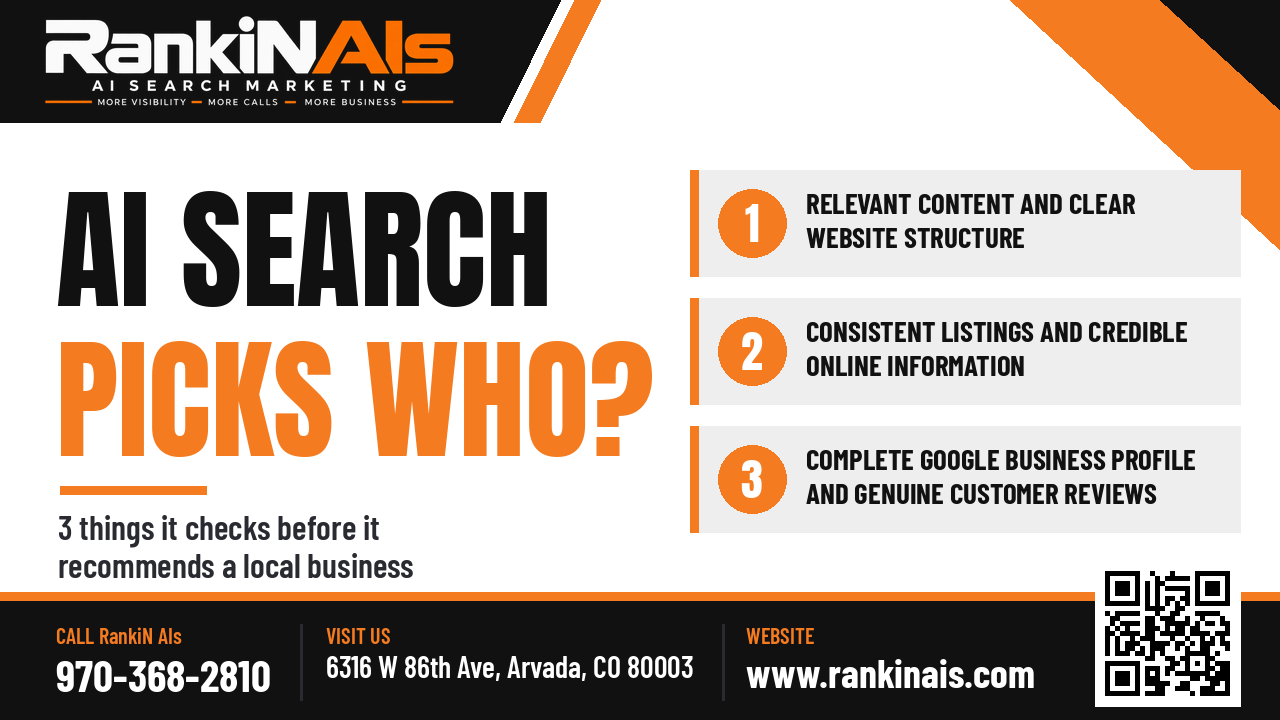
Here's how AI recommends local businesses. It names the few businesses that the sources it reads at that moment describe clearly and consistently. Before an assistant names you, it checks three things. Does your website clearly say what you do and where? Do your listings and public records agree with each other? Do a complete Google Business Profile and real customer reviews back you up? At RankiN AIs in Arvada, Colorado, those three checks are where every audit starts.
Key takeaways
- AI answers are short. BrightLocal's study of 200,000 local prompts found 2 to 4 businesses per answer on ChatGPT, Google AI Mode and AI Overviews.
- Your website matters most. Business websites made up 93% of the domains those AI answers used as sources.
- ChatGPT and Google read different places. Google's AI leans on your Google Business Profile. ChatGPT leans on web search partners, Yelp data, the Better Business Bureau and licensing records.
- One check proves nothing. In 8ight's test, when ChatGPT got the same local question twice, only 29% of the businesses repeated.
What does AI check before it recommends a local business?
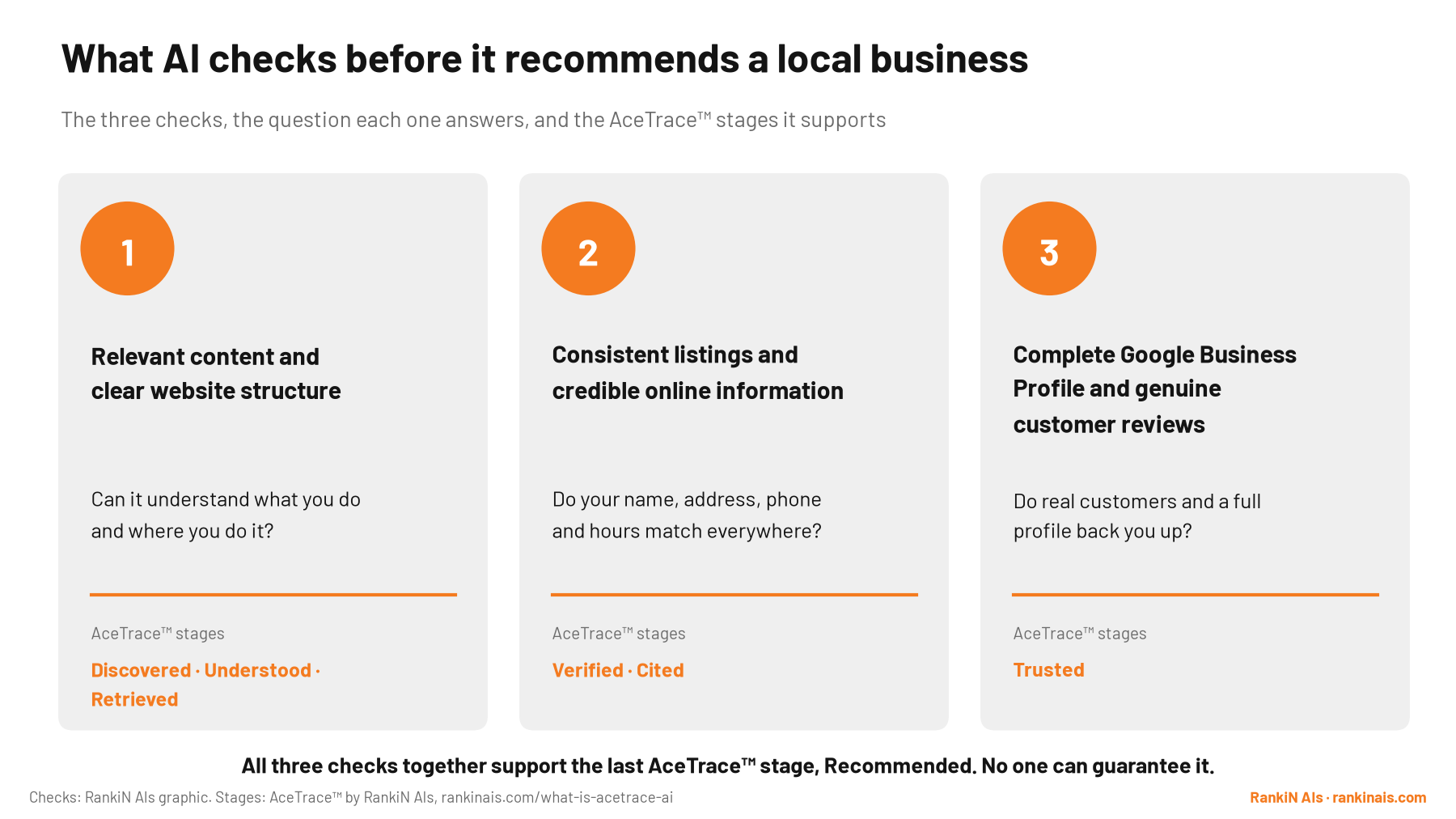
AI checks whether it can understand your business, verify it and trust it. In practice that comes down to three things:
- Relevant content and clear website structure. Your site says what you do, for whom and where, in plain text a crawler can read.
- Consistent listings and credible online information. Your name, address, phone number and hours match across your website, directories and public records.
- A complete Google Business Profile and genuine customer reviews. Reviews from real customers about real jobs are the proof.
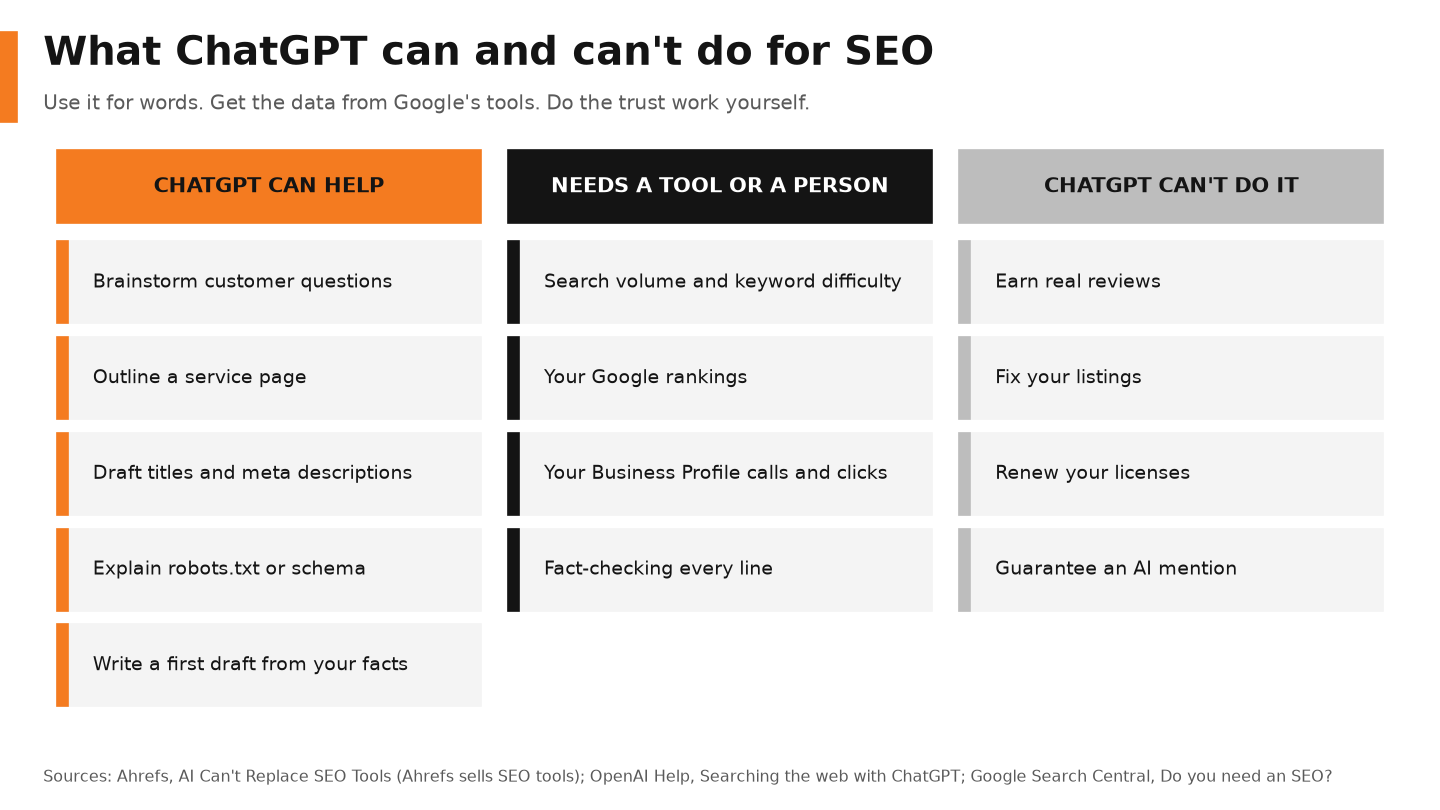
None of this is a trick. Google's guidance for AI Overviews and AI Mode says there are no additional requirements and no special optimizations beyond normal SEO, and it tells site owners to keep their Business Profile information up to date. The work is making true information easy to find, read and confirm.
Why does this matter for a business in Arvada or the Denver metro?
It matters because AI gives a shortlist, not a page of results. Google Maps can show a long list for "roofer near me." An AI answer names a few businesses and stops.
BrightLocal tracked 1,342 locations for 60 days. Google Maps mentioned a tracked business in 66% of searches, while ChatGPT, AI Mode and AI Overviews mentioned it 32% to 38% of the time. A good map pack ranking doesn't carry over on its own. The same report says 45% of consumers used ChatGPT or another AI tool for local business recommendations in early 2026.
I realized AI was taking over search and that it's the future, so instead of waiting around, I jumped in full throttle. I set out to learn how these AIs crawl and search, and I spent a lot of time reading Google's patents. Along the way, I realized a search can be zero-click: people get the answer from their AI and never visit your website.
How does AI search choose local businesses?
AI search turns the question into several smaller web searches, reads a handful of pages, and names the businesses those pages describe clearly. Google calls the first step query fan-out. It runs related searches across subtopics and data sources before it writes the answer.
Here's what that looks like in each tool:
- ChatGPT rewrites your question into targeted queries and sends them to search partners, and OpenAI's help page lists Microsoft's privacy statement among them. It estimates your general location from your IP address. OpenAI's own example turns "good restaurants near me" into "top restaurants San Francisco."
- Gemini and Google AI Mode sit on Google Search and Google Maps. Peekl's testing found Gemini ran 4.6 searches per answer on average when it searched.
- Every tool returns a short list. BrightLocal measured an average of 4.1 businesses per ChatGPT answer, 3.5 for AI Mode and 2.5 for AI Overviews.
The list also moves. When 8ight asked ChatGPT the same local question twice, a median of 39 minutes apart, only 29% of the businesses named showed up in both answers. Yext found all four engines it tested picked the same top business in just 4% of 491,972 shared cases. So the goal is to show up often, across many asks, on the tools your customers use.
Check 1: Does your website clearly explain what you do and where?
Your website is the source AI leans on most. In BrightLocal's data, 93% of the domains AI used as sources were business websites. Those business websites made up 42% of all citations. Yext found the winning business's own site among the cited pages in 91% of cases where all four engines agreed on the top pick.
Search Atlas measured 104,855 AI citations and found semantic relevance had the strongest link to how citations ranked. Semantic relevance means how closely the page matched the question. Domain authority didn't line up with rank.
Give every service its own page
Whitespark surveyed 47 local search experts for its 2026 ranking factors. They put "Dedicated Page for Each Service" at #2 for AI search visibility, right behind being on expert-curated best-of lists.
One page that lists "roofing, gutters, siding, windows" gives AI nothing specific to match. A roof replacement page that says what's included, how long it takes, what to budget, which neighborhoods you serve and which permits apply gives it plenty.
Say where you work, specifically
Whitespark's experts ranked geographic relevance, meaning city and neighborhood names in your content, #6 for AI visibility. Yext found location pages had the biggest lift of any profile signal, 2.9 times, in being named.
For a Front Range business that means naming real places in real sentences. "We replace roofs in Arvada, Westminster and Wheat Ridge" beats a footer list of 40 suburbs. Each service-area page needs something true and local on it, such as a project, a permit detail or a photo from the job. If you can't write something real about a town, don't make a page for it.
Write so a machine can lift the answer
AI quotes passages, so build each page from sections that make sense alone.
- Use question headings that match what people ask, such as "How long does a roof replacement take in Colorado?"
- Answer in the first sentence under the heading, then add the details.
- Make each section stand alone. Don't write "as mentioned above."
- Put facts in visible text, such as prices, service areas, license numbers and hours.
I tie it together with an entity chain, the same way I describe it in our guide on how to improve AI search visibility:
Roofing contractor → Roof replacement → Hail damage repair → Arvada → Denver metro → Google Business Profile → Reviews
Every page on the site should back up that same chain.
Let the crawlers in, and keep schema honest
None of the writing matters if the bots can't read it. OpenAI says sites that opt out of OAI-SearchBot won't be shown in ChatGPT search answers. OpenAI treats GPTBot, its training crawler, as a separate setting, so blocking GPTBot doesn't remove you from ChatGPT search. Perplexity says PerplexityBot is the crawler that surfaces sites in its search results. Anthropic says blocking Claude-SearchBot may reduce your visibility in Claude's search results. Check that your robots.txt and firewall allow Googlebot, Bingbot, OAI-SearchBot, PerplexityBot and Claude-SearchBot.
Google has one more gate. A page has to be indexed and eligible to show with a snippet before AI Overviews or AI Mode can link to it, so check that a noindex or nosnippet tag isn't hiding your key pages. Put your main text in the HTML the server sends, because a service list that only loads through JavaScript may be invisible to non-Google bots.
Schema.org markup helps search engines read a page, but it doesn't replace visible text. Google says structured data should match the visible text and that its AI features need no special schema. Use LocalBusiness schema because it's correct, and don't expect it to carry a weak page.
Check 2: Do your listings and public records agree with each other?
AI cross-checks your basic facts, and Peekl found that when sources conflict, the assistant hedges and names a business it's more sure about. If your website shows one phone number and three directories show another, a competitor whose details all match looks safer.
Google's Business Profile help page says that if your business info isn't accurate, your Business Profile might not show up for relevant searches.
NAP and hours have to match everywhere
NAP means name, address and phone number. Add hours and categories to that list. They should read the same on your website, Google Business Profile, Bing Places, Apple Business, Yelp, Facebook, BBB and your industry directories.
One old address or one wrong set of hours on a single listing is enough to create a conflict. Fix it so every listing matches.
Hours need extra care. Whitespark's experts ranked "Business is Open at Time of Search" #5 for map pack rankings in 2026. Darren Shaw, who runs the survey, warns against listing hours other than your real ones for any location people might walk into.
Public records count
ChatGPT reads government sites. In 8ight's September 2026 data, ChatGPT cited the Better Business Bureau in 39% of local answers. It cited a government site in 25% of them. About 7 in 10 of those government citations were licensing boards, license look-ups and contractor registries. A lapsed license or an old business name in a public registry sits on exactly the kind of page ChatGPT cites.
Arvada is a good example. The city requires a license for contractors doing construction, alteration, remodeling or repair work. Contractors have to re-apply every year. If your city license lists an old trade name or address, fix it.
Third-party listings each AI tool pulls from
- Yelp. Yelp licenses its reviews, ratings, photos and business details to OpenAI for ChatGPT. Yelp already supplies data to Apple Maps.
- Bing Places. In a February 2025 test of more than 500 citations, Seer Interactive found 87% of ChatGPT search citations matched Bing's top 20 results.
- Apple Business. Apple replaced Apple Business Connect with Apple Business on April 14, 2026. Your place card shows up across Apple Maps, Safari and Spotlight. Apple says it also helps businesses reach customers on Siri. Existing Business Connect data moved over automatically, so log in and check it.
- Best-of lists and industry directories. Whitespark's experts ranked expert-curated best-of lists as the #1 AI visibility factor. Darren Shaw's advice is to ask the sites that publish those lists to include you. Expect to earn it.
Check 3: Is your Google Business Profile complete, and are your reviews real?
Your Google Business Profile, or GBP, is the free listing that shows your business on Google Search and Google Maps. A complete GBP and a steady flow of genuine reviews matter most on Google's own AI. In BrightLocal's data, Google Business Profile made up 28.6% of all citations, the largest single source. It was the top source for AI Mode and AI Overviews. ChatGPT hardly used it.
What a complete profile looks like
Google's help page lists the basics. Verify the profile, keep your address, hours and category accurate, respond to reviews and add photos. Google ranks local results on relevance, distance and prominence. Google also says there's no way to pay for a better local ranking.
Yext compared the businesses that all four engines picked first with the typical field. The biggest gaps are review depth and recent activity.
| Profile signal | Unanimous top picks | Typical field |
|---|---|---|
| Median reviews | 568 | 19 |
| New reviews per month | 12.2 | 1.9 |
| Reviews answered | 62% | 33% |
| Local-business schema | 56% | 30% |
| Profile completeness | 95% | 80% |
| Average star rating | 4.2 | 3.7 |
Source: Yext Research, February to August 2026. Don't read 568 reviews as a target for a two-truck plumbing shop. Read the direction instead, which is more recent reviews and more replies.
Reviews back you up, but they don't decide
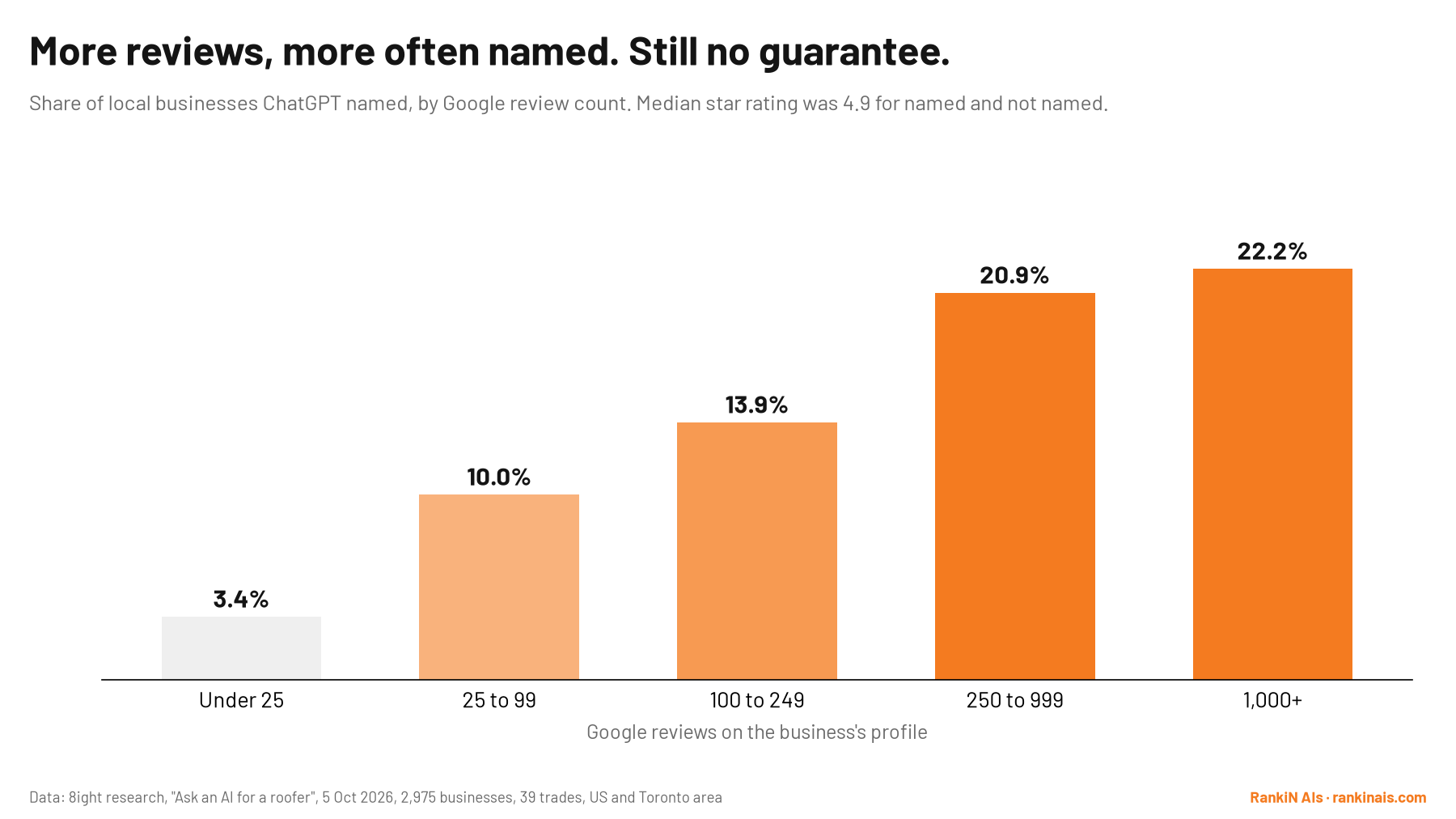
More reviews went with being named more often. In 8ight's data, ChatGPT named 3.4% of businesses with fewer than 25 Google reviews and 22.2% of those with 1,000 or more. The businesses it named had a median of 175 reviews against 97 for the rest. Yet the most-reviewed business 8ight checked in each place was still left off ChatGPT's list about three times in four. Star ratings didn't separate anyone, since both groups had a median of 4.9.
What customers write matters too. Peekl found that a specific concern raised in recent reviews may get repeated in the AI's answer.
Get reviews the honest way. Ask every customer, make it easy, and reply to every review, good or bad. Never pay for reviews, offer a discount for them, write them yourself, or only ask the customers you know are happy. Google's Maps policy bans paid, incentivized and selectively solicited reviews.
Which sources does each AI tool lean on?
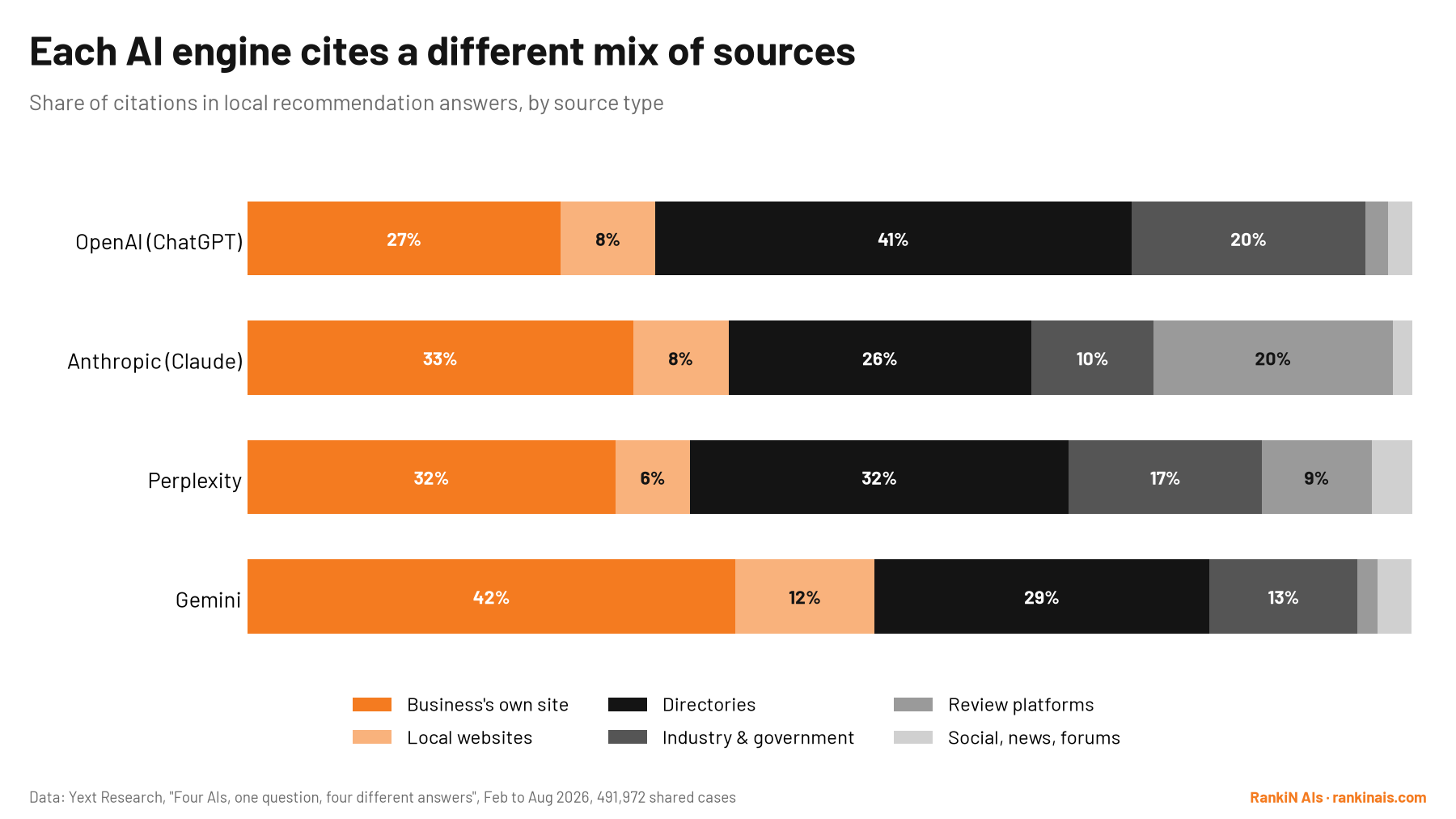
Each AI tool reads a different mix of sources, so one listing won't cover you everywhere.
| AI tool | Where it looks | What it cites or uses most | Fix first |
|---|---|---|---|
| ChatGPT | Search partners including Microsoft, its OAI-SearchBot crawler, location from IP | Directories 41% of citations per Yext. BBB in 39% of answers and government sites in 25% per 8ight. Yelp business details through a licensing deal. | Allow OAI-SearchBot. Set up Bing Places and Bing Webmaster Tools. Match Yelp, BBB and license records to your site. |
| Gemini | Google Search and Google Maps | The business's own site, 42% of citations per Yext | Google Business Profile, plus strong service and location pages |
| Google AI Mode and AI Overviews | Google's index and Maps data | Google Business Profile is the #1 source per BrightLocal, then Yelp and Facebook | A complete, verified Google Business Profile |
| Perplexity | Its own crawler, PerplexityBot | An even split of brand sites and directories, about 32% each per Yext | Allow PerplexityBot. Build directory coverage. |
| Siri and Apple Maps | Apple Business place cards plus partner data | Yelp supplies business information to Apple Maps | Claim your Apple Business place card. Keep Yelp accurate. |
| Claude | Web search, plus its Claude-SearchBot crawler | Yelp in 93% of local answers per 8ight. Review sites 20% of citations per Yext. | Allow Claude-SearchBot. Keep Yelp and review sites accurate. |
One note on ChatGPT and Yelp. 8ight saw ChatGPT cite Yelp in zero of 1,412 API answers. Peekl's explanation is that Yelp content appears inside the ChatGPT app as business details, not as a cited link. So don't judge Yelp by whether it shows up in the sources list.
Why do the studies disagree about stars, schema and Google Business Profile?
They measure different things. Once you see what each one counted, they mostly agree.
- Star rating. 8ight found a higher rating didn't go with being named. Named and skipped businesses both had a median of 4.9, so ratings had little room to separate them. Yext found the median top pick had a 4.8 rating. Yet the highest-rated business in a list ranked first only 40% of the time, and Yext describes rating as shaping the order inside a list.
- Schema. Search Atlas found near-zero correlation between schema and how cited URLs were ordered. Yext found a 2.1 times lift in whether a business was named. Yext also says its study doesn't claim any one field causes selection, so the lift may belong to the whole well-built site.
- Google Business Profile. BrightLocal calls it the #1 source. BrightLocal mostly measured Google's own AI, which reads GBP directly. Search Atlas found a modest correlation of about 0.16 across six platforms, including ChatGPT, which barely uses GBP.
In practice, build the website first because every engine uses it. Then make your facts match everywhere. Then grow reviews and keep the profile active. Which step matters most depends on which AI tool your customers use.
What does this look like for an Arvada or Denver-metro business?
Distance works differently in ChatGPT than in Google. BrightLocal found 90% of ChatGPT's picks fell within 287 km of the searcher, against 38 to 64 km for Google's AI. ChatGPT turns a "near me" question into a search with a city name in it, as OpenAI's own example shows.
For an Arvada business, that means a Denver-wide question can pull you in if the web clearly ties you to the trade and the area. It can also hand the answer to a downtown Denver competitor with more coverage. Yext adds that engines agreed on a top pick 23.7% of the time in rural markets and 12.5% in very dense ones. In a busy metro the top pick changes more often, so matching facts across sources matter more.
Arvada also sits in two counties, Jefferson and Adams. Use one city name and one address format on every listing.
A few Denver-metro checks I'd run first:
- Your City of Arvada contractor license, or the license in your own city, shows your current business name and address.
- Your service-area pages name the towns you work in and say something true about each one.
- If you're a service-area business without a storefront, your website and reviews carry more of the load. BrightLocal found storefronts were mentioned 33.6% of the time against 29.4% for service-area businesses.
How we test whether AI recommends a business
RankiN AIs tests a business the way a customer asks, then scores every source the AI used. We call it the AI Search Trust Audit. It starts with five baseline prompts in clean sessions with nothing primed:
| Prompt type | What we ask | Tools | What we log |
|---|---|---|---|
| Best provider | Who is the best [service] in [city]? | ChatGPT, Gemini, Perplexity, Google AI | Businesses named, order, sources, confidence |
| Trust | Is [business name] legit? | ChatGPT, Perplexity | Accuracy, reviews, complaints, source links |
| Comparison | Who should I hire, [business] or [competitor]? | ChatGPT, Gemini, Perplexity | Which company wins and why |
| Emergency | Who should I call for emergency [service] in [city]? | ChatGPT, Google AI, Perplexity | Speed claims, hours, competitors, citations |
| Entity facts | What services does [business name] offer? | ChatGPT, Gemini | Wrong facts, missing services, outdated info |
Every source the AI cites gets an EcoGEO evidence score from 0 to 5:
| Score | Meaning | Example |
|---|---|---|
| 0 | Missing or unusable | No GBP, dead page, no review profile |
| 1 | Very weak | Old directory listing with the wrong phone number |
| 2 | Weak | Service page with no local proof |
| 3 | Adequate | Valid listing with a generic description |
| 4 | Strong | Review page with relevant service and location themes |
| 5 | Excellent | Detailed service page with proof, FAQs, schema and local examples |
The low scores become a 30-day fix list. Each fix gets an owner, a due date and proof that it's done. Then we run the same prompts again and count how often the business is named across several runs, because one answer proves little.
The audit has firm rules. We don't fake reviews, citations or accounts, we don't post on forums for a client, we don't hide negative evidence, and we never promise an AI placement. OpenAI's own help page says placement is not guaranteed.
What shouldn't you do to get recommended by AI?
Skip anything that fakes the evidence. AI cross-checks sources, and Google removes fake reviews under its Maps policy.
- Don't buy reviews, write your own, or offer anything in exchange for one.
- Don't stuff keywords into your Google Business Profile name, description or posts. Whitespark's experts list all three as suspension risks.
- Don't list hours you don't keep.
- Don't build "independent" review sites or forum posts about yourself.
- Don't hide text on your pages that only bots can see.
- Don't pay anyone who promises a spot in ChatGPT. Peekl notes there's no program to submit or claim a local listing in ChatGPT.
Questions to ask about your own business
- If ChatGPT read only my website, could it say what I do, in which towns, and why someone should pick me?
- Does every service I sell have its own page?
- Do my name, address, phone number and hours match on my site, Google Business Profile, Bing Places, Apple Business, Yelp and BBB?
- Is my contractor or trade license current, and does it show my current business name?
- Does my robots.txt allow OAI-SearchBot, PerplexityBot, Claude-SearchBot and Bingbot?
- Did I get a new review this month, and did I reply to the last one?
- Which sources does AI cite for my competitors that it doesn't cite for me?
How the three checks map to AceTrace
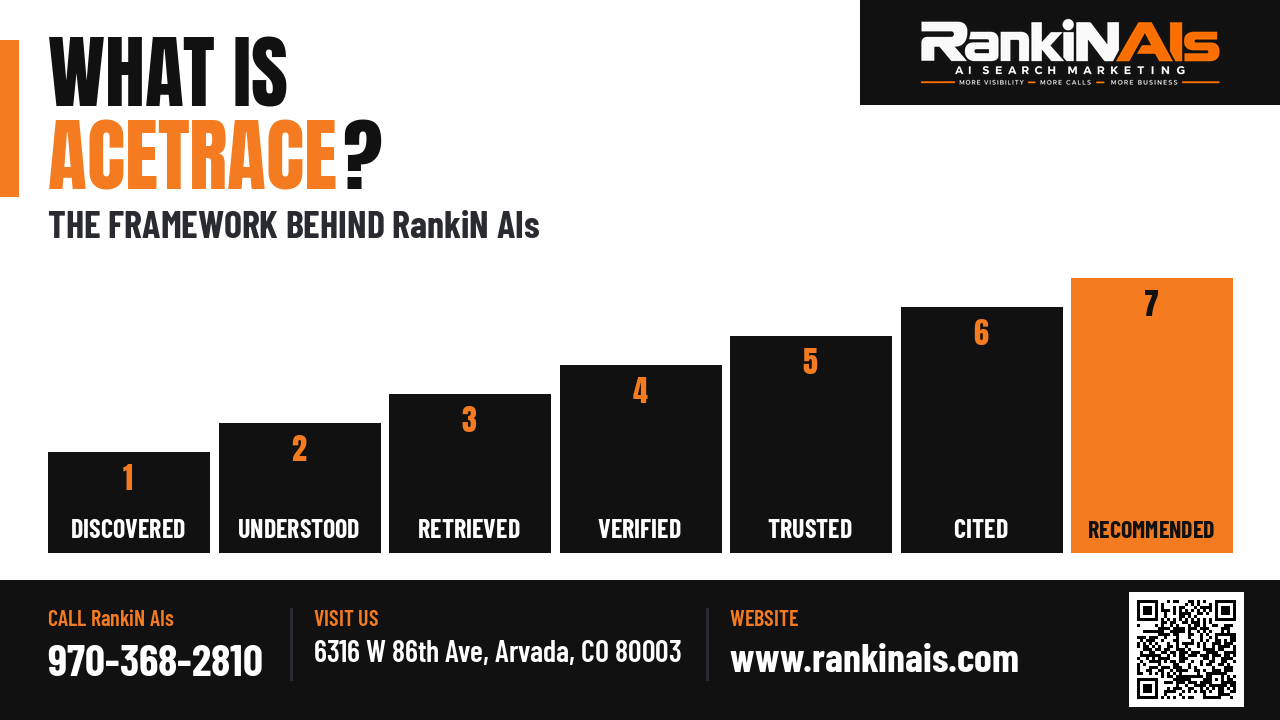
AceTrace is RankiN AIs' AI Citation Engineering framework. Its implementation model is TRACE, which stands for Trust, Retrieval, Authority, Citations and Evidence. AceTrace follows a business through seven stages:
| AceTrace stage | What RankiN AIs works on | Check that supports it |
|---|---|---|
| Discovered | Make the business discoverable. | 1. Relevant content and clear website structure |
| Understood | Make the business and its services clear. | 1. Relevant content and clear website structure |
| Retrieved | Make important information accessible and relevant. | 1. Relevant content and clear website structure |
| Verified | Create consistent supporting information. | 2. Consistent listings and credible online information |
| Trusted | Build credible signals and useful evidence. | 3. Complete Google Business Profile and genuine reviews |
| Cited | Strengthen relevant references across the web. | 2. Consistent listings and credible online information |
| Recommended | Help search systems connect the business with relevant customer needs. | All three checks together |
The stages build on each other. Great reviews do less when AI can't read your site well enough to know what those reviews are about. AceTrace doesn't guarantee a citation or a recommendation, because each AI system controls its own retrieval and answers.
FAQ
How does AI decide which local businesses to recommend?
AI recommends the businesses that the sources it reads at that moment describe clearly and consistently. It runs several web searches, reads sources such as your website, Google Business Profile, directories, review sites and licensing records, and names the few businesses those sources back up.
Does ChatGPT use my Google Business Profile?
ChatGPT mostly doesn't. BrightLocal found Google Business Profile was hardly used by ChatGPT, which leans on web search partners, Yelp business data, the Better Business Bureau and government licensing sites. Google's AI Mode and AI Overviews use your Google Business Profile heavily.
Why does AI recommend a different business every time I ask?
AI answers change from run to run. 8ight found only 29% of businesses repeated when ChatGPT got the same local question twice, so the goal is to show up often across many asks.
Can I pay to get my business recommended by ChatGPT?
No. OpenAI says placement in ChatGPT search isn't guaranteed, and there's no program for a local business to submit or claim a listing.
Do star ratings matter for AI recommendations?
Star ratings matter less than review count, recency and replies. In 8ight's data, the businesses ChatGPT named and the ones it skipped both had a median of 4.9 stars, while the named ones had more reviews.
If I rank in Google Maps, will AI recommend me too?
Not necessarily. BrightLocal found Google Maps mentioned a tracked business in 66% of searches, against 32% to 38% for ChatGPT, AI Mode and AI Overviews.
About the author. Jonathan Otto has 15 years of experience building websites, SEO and graphic design.
About RankiN AIs. RankiN AIs is an AI search marketing and SEO agency based in Arvada, Colorado, serving businesses throughout the Denver metro area. Services include AI search optimization, local SEO, and Google Business Profile management to improve visibility across Google Search, Google Maps, and AI search platforms. The proprietary AceTrace AI Citation Engineering framework focuses on trust, retrieval, authority, citations, and evidence to strengthen online discoverability and credibility. RankiN AIs prioritizes meaningful business outcomes, including qualified calls and leads—not just rankings. Start your 14-day free trial today.
Want to see what ChatGPT, Gemini and Google say about your business, and about your top competitor? Start a 14-day free trial with RankiN AIs, or call 970-368-2810 or email john@rankinais.com.
RankiN AIs, 6316 W 86th Ave, Arvada, CO 80003, 970-368-2810
Open 24 hours, 7 days a week.
You can also read more about our AI search optimization and local SEO services.