By Jonathan Otto, Founder, RankiN AIs, Arvada, CO · Published October 24, 2026 · Last updated October 24, 2026
AI search picks the local businesses that its sources describe clearly and consistently, then names only a few of them. BrightLocal's study of 200,000 local prompts found an average of 2.5 to 4.1 businesses per answer, depending on the tool. RankiN AIs in Arvada, Colorado, wrote this guide so you can check where your business stands this week.
Key takeaways
- AI answers are short. BrightLocal averaged 4.1 businesses per answer for ChatGPT, 3.5 for Google AI Mode and 2.5 for Google AI Overviews.
- The tools disagree. Yext found four AI engines chose the same top local business in 4% of 491,972 shared cases and four different businesses in 48%.
- Picking has two steps. Yext says a business must first enter an engine's consideration set, then earn a higher spot inside it.
- Each tool reads different places. 8ight found Claude cited Yelp in 93% of local answers and ChatGPT cited it in none of 1,412.
- One answer proves little. 8ight found a median 29% of the businesses named were the same when ChatGPT got one question twice.
- You can run the five-day Pick check below. It promises no placement, because nobody controls the picks.
What does it mean when AI search "picks" a business?
AI search picks a business in two steps. It first builds a pool of candidates, which Yext calls a consideration set. It then orders the names in that pool and shows the first few.
Yext's study of 491,972 shared local cases says each engine starts with a different set of businesses. Ratings, review depth, recent activity and clear business data then shape which name reaches the top.
That makes two separate jobs. The first is to be easy for an engine to find and read. The second is to earn the trust signals that rank you inside the set. Yext puts the order plainly: "Start with legibility. A rating cannot influence a recommendation when the engine never finds the location."
How many businesses does AI name for a local question?
AI names a small slice of a market. The two largest studies count it differently, so the table shows both.
| Study | What it measured | Result |
|---|---|---|
| BrightLocal, 200,000 non-branded prompts | Average businesses per answer | ChatGPT 4.1, Google AI Mode 3.5, Google AI Overviews 2.5 |
| Yext, "top 10" prompts on four engines | Average businesses per engine | About 7, even when asked for 10 |
| Yext, companion Google local search | Businesses in a typical market | About 37 |
| Yext | Different businesses named across all four engines | 23 on average |
The counts differ because the prompts differ. BrightLocal used non-branded prompts that a local business could be recommended for. Yext asked "What are the top 10 [category] near [neighborhood]?" Both studies agree on the point. Each engine named about 7 of the roughly 37 businesses a Google local search surfaced in a typical market.
Why do AI tools pick different businesses?
AI tools pick different businesses because they read different places. The table pulls the main sources from three studies.
| Tool | Where it leans | Study |
|---|---|---|
| Google AI Mode and AI Overviews | Google Business Profile, the top source for both | BrightLocal |
| ChatGPT | Directories, industry and government pages, the Better Business Bureau in 39% of answers and government or licensing sites in 25% | Yext and 8ight |
| Claude | Review platforms, with Yelp in 93% of local answers | Yext and 8ight |
| Gemini | The business's own site, 41.9% of its citations | Yext |
| Perplexity | An even split, 31.6% own sites and 32.5% directories | Yext |
Four limits apply. 8ight asked each engine through its API with web search on, and an app user can get a different answer. Yext's shares describe the sources named in answers, not every signal an engine uses. All three studies come from companies that sell local search or AI visibility products. None of the three tested DeepSeek, so it has no row in the table.
What gets a local business into the shortlist?
Clear location data gets a business into the shortlist. Yext matched profiles and found these traits appear more often on businesses that AI engines named.
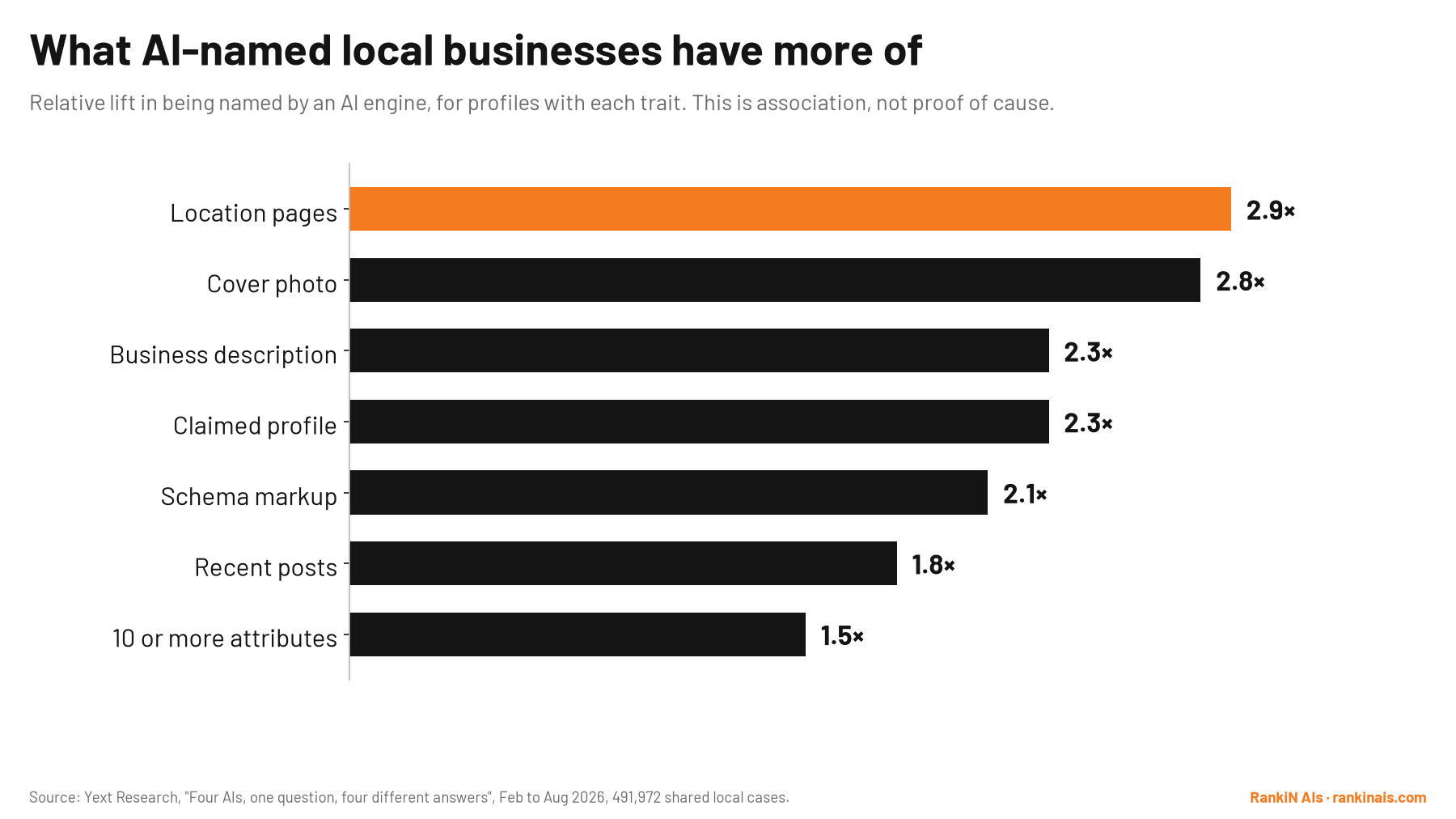
Yext says the study shows which businesses appear more often and which traits go with them. It does not claim that one field causes selection.
For an Arvada business, three of those traits are plain to act on:
- A page on your site for each location you serve, with Arvada and the nearby towns named in the text.
- A claimed Google Business Profile with a written description.
- A cover photo and recent posts that show a real, active business.
Google also says there is nothing special to add. Its AI features guidance says there are no additional requirements to appear in AI Overviews or AI Mode. A page must be indexed and eligible to show with a snippet, and Google asks you to keep your Business Profile information up to date.
What helps a business once it is in the shortlist?
Reviews and fresh activity help once a business is in the set, and star ratings help less than most owners expect. 8ight found ChatGPT named 3.4% of businesses with fewer than 25 Google reviews and 22.2% of those with 1,000 or more. The most-reviewed business in a city was still left off about three times in four. Named and unnamed businesses both had a median rating of 4.9 stars.
Yext saw the same limit. The highest-rated business in a returned list ranked first only 40% of the time. Review depth, recent activity and replies showed bigger gaps than star rating. The Google Business Profile checklist covers those numbers.
What can an Arvada owner check this week? The Pick check
The Pick check is a five-day routine, plus a re-run. It follows the two steps above. Days one and two show you the picture. Days three to five fix what the sources read about you.
| Day | Do this | Why |
|---|---|---|
| 1 | Ask ChatGPT, Gemini, Perplexity and DeepSeek the same local question, three times each. Name Arvada in the question. Write down every business named. | One answer proves little. 8ight saw a median 29% overlap between two runs. |
| 2 | Open the sources each answer cites. Note which sites list your competitors and not you. | Each tool reads different places. |
| 3 | Compare your name, address, phone and hours on your website, your profile and the sites from day 2. Fix mismatches. | Google builds profiles from your website, licensed third-party data and public contributions. |
| 4 | Open your Google Business Profile. Check the category, description, services, photos and review replies. | Google says complete and accurate profiles are more likely to show in local results. |
| 5 | Check your website. Each service needs its own page, with the city in the text. The page must be indexed. Your robots.txt must allow OAI-SearchBot. | Google requires indexing and snippet eligibility. OpenAI says to allow OAI-SearchBot to be eligible for ChatGPT search. |
| 7 or later | Repeat day 1 with the same wording and compare the lists. | The re-run shows whether a fix moved anything. |
Day 1 in full is in the self-check guide, with prompts and a log sheet. Day 3 in full is in the matching guide.
OpenAI also says that if local results show the wrong area, you can include your city, neighborhood or postal code in the question. Do that in every prompt.
What does this look like in Arvada and the Denver metro?
Distance works differently in each tool. BrightLocal found 90% of ChatGPT's picks fell within 287 km, about 178 miles, of the searcher. For Google's AI the same share fell within 38 to 64 km, about 24 to 40 miles. ChatGPT can therefore name businesses far from Arvada, and Google's AI stays closer.
Crowded markets split the picks more. Yext found three or four engines agreed on the top business 23.7% of the time in rural markets and 12.5% in very high density ones. Yext does not say which band the Denver metro falls in, so treat that range as a direction, not a forecast.
Two Arvada details help you keep facts straight:
- Arvada sits in both Jefferson and Adams counties, according to Wikipedia.
- For ZIP code 80003, Hometown Locator lists Arvada as the USPS preferred city and Westminster as an acceptable one. Pick one city name and use it everywhere.
FAQ
How does AI search decide which local business to name?
AI search names the businesses that the sources it reads describe clearly and consistently. It builds a pool of candidates, then orders them using signals such as reviews, ratings, recent activity and complete business data. Yext found each engine starts with a different pool.
How many local businesses does AI name in one answer?
AI names about 2 to 4 local businesses per answer on average. BrightLocal measured 4.1 for ChatGPT, 3.5 for Google AI Mode and 2.5 for Google AI Overviews. Yext got about 7 per engine when it asked for a top 10.
Why does ChatGPT name different businesses than Google?
ChatGPT and Google read different sources. BrightLocal found Google Business Profile was the top source for Google's AI tools. 8ight found ChatGPT cited a Google Maps or business page in 0.2% of answers and leaned on the Better Business Bureau and government sites.
Does having more reviews guarantee AI names my business?
No. 8ight found more reviews went with being named more often, but the most-reviewed business in a place was still left off about three times in four. Star rating did not separate named and unnamed businesses.
Can I pay to be picked by AI search?
No. OpenAI says placement in ChatGPT search is not guaranteed. Google says there is no way to request or pay for a better local ranking. RankiN AIs cannot promise a placement either.
How many times should I ask before I trust the result?
No study sets a number. 8ight compared two runs of one question and found a median 29% overlap. RankiN AIs suggests asking each question at least three times per tool, then comparing lists. That count is our suggestion, not a study threshold.
About the author. Jonathan Otto has 15 years of experience building websites, SEO and graphic design. He is the founder of RankiN AIs.
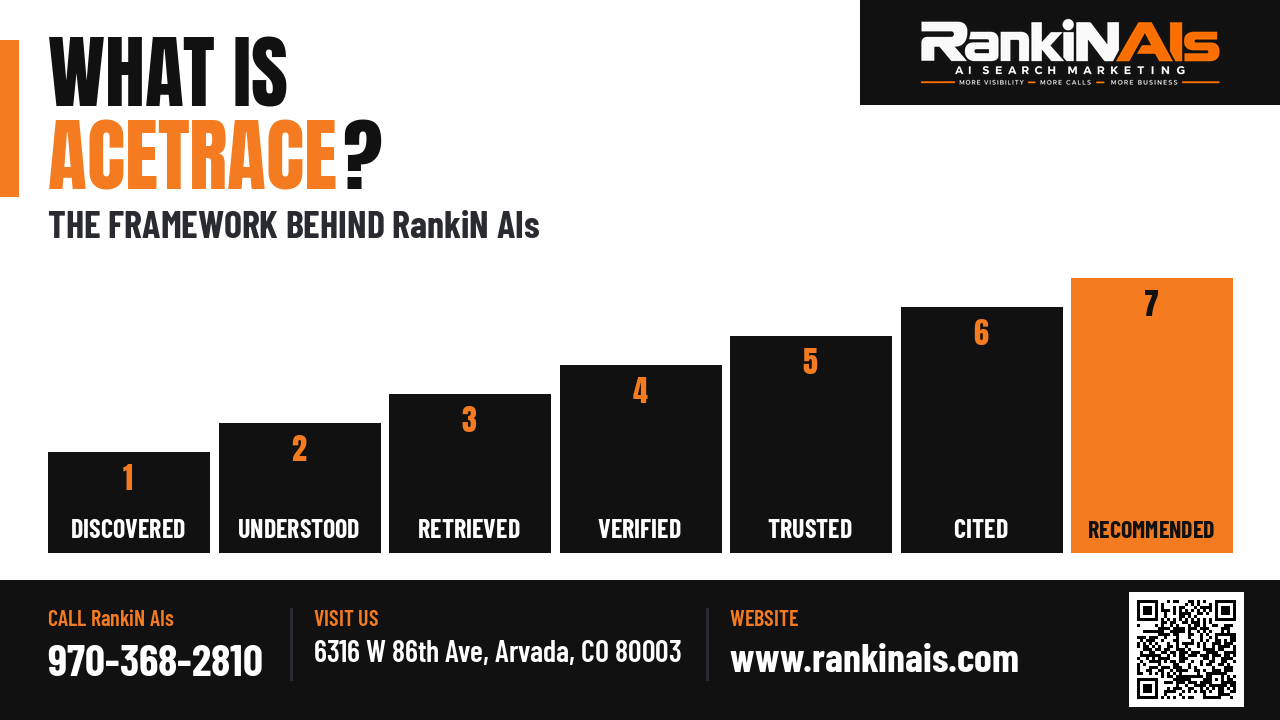
About RankiN AIs. RankiN AIs is an AI search marketing and SEO agency based in Arvada, Colorado, serving businesses throughout the Denver metro area. Services include AI search optimization, local SEO, and Google Business Profile management to improve visibility across Google Search, Google Maps, and AI search platforms. The proprietary AceTrace AI Citation Engineering framework focuses on trust, retrieval, authority, citations, and evidence to strengthen online discoverability and credibility. RankiN AIs prioritizes meaningful business outcomes, including qualified calls and leads—not just rankings. Start your 14-day free trial today.
Want help running your own Pick check? Start a 14-day free trial with RankiN AIs, or contact RankiN AIs. You can also call 970-368-2810 or email john@rankinais.com.
RankiN AIs, 6316 W 86th Ave, Arvada, CO 80003, 970-368-2810
Open 24 hours, 7 days a week.
Related reading: How AI Recommends Local Businesses, And The 3 Things It Checks First.